To meet Common Core's goal of developing college and career ready students, you need a curriculum that moves beyond basic recall and memorization. With TCI's rich resources, students read, write, speak, and listen as they master the discipline of social studies in a meaningful way.
Here's an example of how one of our elementary lessons addresses these key areas of the Common Core.
Key Points from the E-LA Common Core |
TCI Materials |
Images |
|
Reading
- Informational and literary texts are balanced with at least 50% of reading time devoted to expository texts.
- Establishes a "staircase" of increasing complexity in what students must be able to read as they move throughout the grades.
- Emphasizes the close reading of text to determine main ideas, supporting details, and evidence.
|
Students analyze images and then read complex text about the Early English Settlements of Roanoke, Jamestown, and Plymouth. Students complete reading notes in their Interactive Student Notebook to record key details. A word bank is provided for each settlement to ensure they are using key vocabulary and citing important details and evidence from the text.
The main text is accompanied by a Reading Further feature that provides detailed information on a special topic. In this Reading Further, students read about King Philip, the leader of the Wampanoag people, and his decision to go to war against the English settlers. Students complete a cause and effect chart to identify events that lead to the war and the war’s impact.
|
|
|
Writing
- Three types of writing are emphasized from the earliest grades—writing to persuade, writing to inform/explain, and writing to convey experience.
- Effective use of evidence is central throughout the writing standards.
- Routine production of writing appropriate for a range of tasks, purposes, and audiences is emphasized.
|
Students complete three different writing tasks—each with a different purpose, audience and length. Students begin this lesson by writing a narrative on the challenges they would face if they attended school in another country. This quick write is designed to get students thinking about the challenges confronted by the early English settlers in the Americas.
After learning detailed information about the English settlements, students complete a persuasive writing assignment that asks them to create an advertisement that encourages people to move to Jamestown or Plymouth. Students are asked to include specific details about the settlement to ensure that they include facts and evidence from the text. Finally, in the lesson assessment students write a friendly letter describing the conditions at Jamestown.
|
|
|
Speaking and Listening
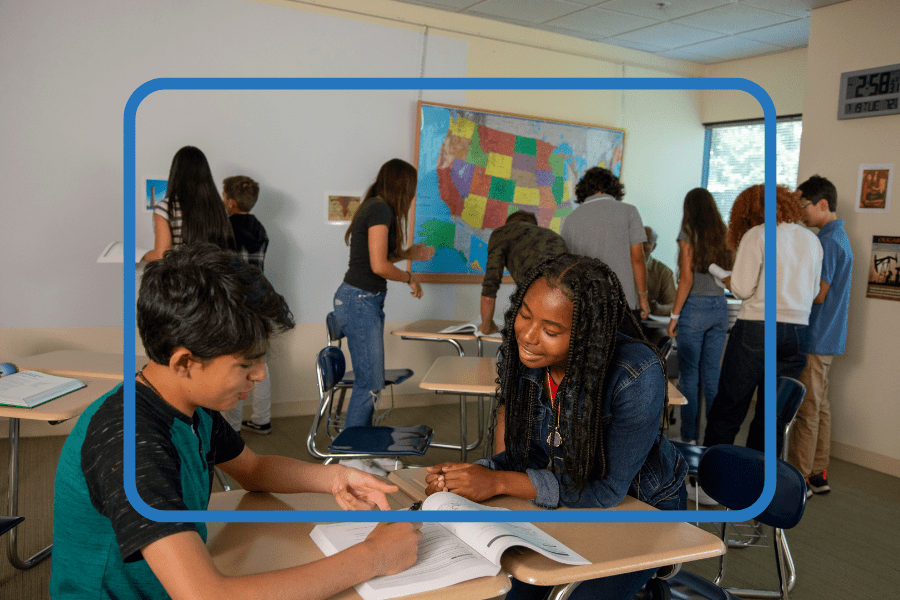
- Participation in rich, structured academic conversations in one-on-one, small-group, and whole class situations is emphasized in the standards.
- Contributing accurate, relevant information; responding to and building on what others have said; and making comparisons and contrasts are important skills for productive conversations.
|
Opportunities for speaking and listening are embedded throughout this lesson in a variety of ways. Students participate in a whole class discussion to analyze historic images of Roanoke, Jamestown, and Plymouth. After reading the text that corresponds to each image, students participate in a small-group discussion centered on a series of structured questions. And, finally, select students take on the role of one of the historical figures in the image and present key information to the class from the perspective of that person.
|
|
|
Language
- Demonstrate command of the conventions of English when writing and speaking.
- Acquire and use general academic and domain-specific words.
- Focus on developing skills to determine or clarify the meaning of unknown works or phrases.
|
Key vocabulary terms are introduced at the beginning of the lesson and students complete a vocabulary development assignment, such as the Word Parts Log. This log trains students to break down words to infer meaning.
An Editing and Proofreading Checklist is included to help students create writing that is free of errors.
|
|