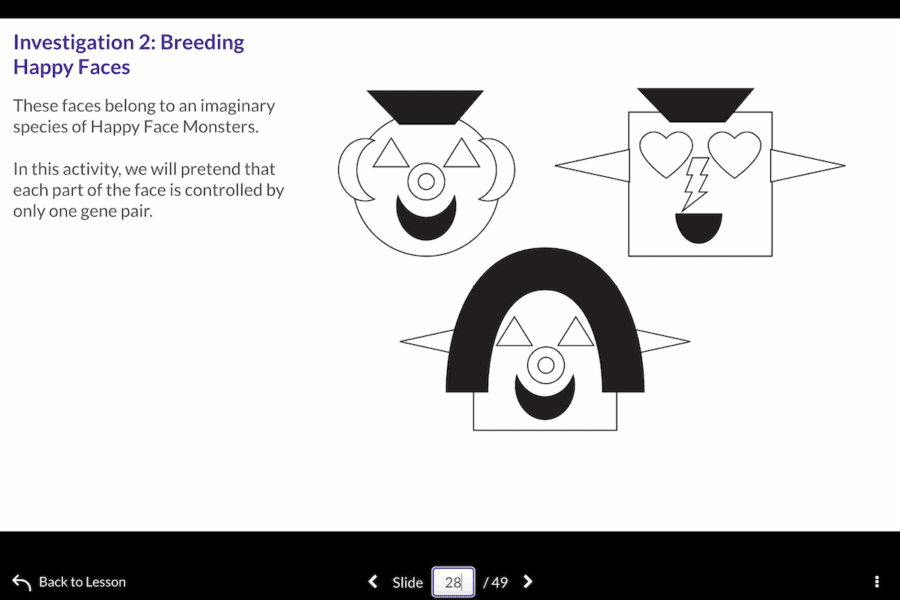
Investigation: Breeding Happy Faces
In this investigation, students model how alleles determine traits and how alleles and traits are inherited.
 |
“When our curriculum director came to us last year and told us that we were up for our cycle for adoption, and asked us to start looking at a new science curriculum, our whole Science Department said, ‘No, we want to stay with TCI.’”
|
For Alicia Kuntz, a veteran 7th-grade science teacher at Niles Community School District in Michigan, 22 years in the classroom have been a journey of dedication to middle school education. Teaching both 7th and 8th-grade science at the same school, Alicia has witnessed firsthand how the right curriculum can transform not just student engagement, but an entire department’s approach to teaching.
“I just finished my 22nd year teaching, and I’ve been at the same school my entire career,” Alicia shared. “We’ve used TCI since the middle school curriculum was released.”
Before discovering TCI’s Bring Science Alive! middle school programs, Alicia and her colleagues faced a familiar challenge that many science teachers know all too well. They were piecing together their own curriculum from various resources, spending countless hours searching for materials that would engage their students and align with standards.
“Before we had TCI, we had to develop our own curriculum, and having to take bits and pieces from everywhere was very time-consuming,” Alicia explained. The district needed something comprehensive, aligned to Next Generation Science Standards (NGSS), and most importantly, something that would make science exciting for middle schoolers.
When it came time to select a new curriculum, the decision was clear. TCI checked all the boxes: “We were definitely looking for something that was aligned to NGSS, and something that was all-inclusive. TCI had everything we were looking for, including the reading components, the activities, and the phenomenon that came along with it.”
TCI’s Bring Science Alive! is built around research-based strategies that transform students from passive observers into active scientists. Through hands-on investigations, phenomenon-based learning, and collaborative activities, students experience science rather than just read about it.
The impact on student engagement was immediate and profound. “The students really enjoy the activities and the investigations,” Alicia noted. “Before they enter middle school, they say that science isn’t very exciting because all they do is read and answer questions. But with TCI, it’s a lot of investigations and group work. Students are actually doing science, not just reading about it.”
This transformation in student attitude reflects TCI’s core philosophy: learning happens best when students are actively engaged in the scientific process, asking questions, conducting investigations, and making connections to the world around them.
One of Alicia’s favorite aspects of TCI is how seamlessly it integrates with other classroom activities and real-world discoveries. “In one of our favorite activities from the Cells and Genetics program, students participate in engaging activities like the monster breeding simulation where they flip the coin to see which allele they get from which parent.”
These lessons spark curiosity in the moment, but Alicia also looks for ways to extend those connections beyond the textbook. “I found a bioluminescent petunia plant right before school got out, so I got to share that with the students, and connect it to the lesson about bioluminescent plankton” Alicia shared. “It’s just all very relevant to what we’re learning in TCI and all the new developments in science.”
The classroom comes alive when students can examine real plants from their hydroponic unit under microscopes while learning about phloem and xylem. “I love how you can integrate additional projects into TCI, and integrate TCI with so many other lessons, too.”
Beyond engagement, TCI has helped develop crucial academic skills that serve students well beyond the science classroom. “Definitely, the reading for comprehension has improved significantly,” Alicia observed. This skill proves invaluable during standardized testing, where students must pull the information from the passages, a practice that aligns perfectly with TCI’s reading-integrated approach.
As the Professional Learning Community (PLC) leader for her department, Alicia has heard feedback from 8th-grade teachers who administer standardized tests. They’ve noted that while the tests focus less on content memorization, they emphasize the critical thinking and comprehension skills that TCI helps develop through its inquiry-based learning approach.
Perhaps the strongest testament to TCI’s impact came recently when the district underwent its regular curriculum adoption cycle. “When our curriculum director came to us last year and told us that we were up for our cycle for adoption, and asked us to start looking at a new science curriculum, our whole Science Department said, ‘No, we want to stay with TCI,” Alicia shared.
This unanimous decision from experienced educators speaks volumes about the program’s effectiveness and the trust it has earned over years of implementation.
See how TCI’s Bring Science Alive! K-8 programs engage students in authentic scientific practices through hands-on investigations, phenomenon-based learning, and engaging content. Contact our sales team to request a sample.
In this investigation, students model how alleles determine traits and how alleles and traits are inherited.
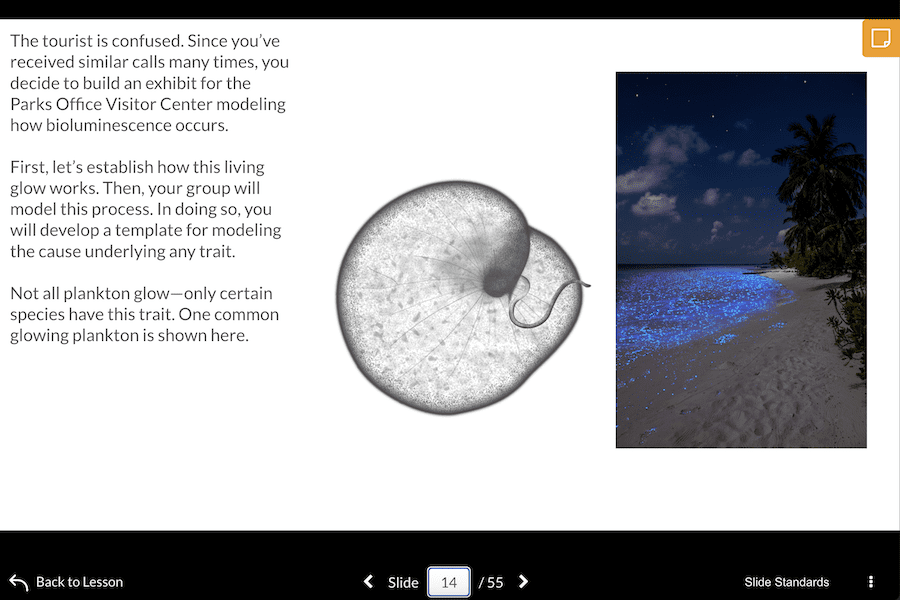
In this investigation, students design and create museum exhibits that explain how a gene in plankton expresses a protein that causes the organism to glow.