Preparing K-12 Students for an AI World Through Active Learning
AI is already changing how students find information, evaluate sources, and interact with the world.
So what does a student who’s ready for that world actually look like? It’s become one of the most important questions in K-12 education. The answer is not new. The skills students need to thrive in an AI world are the same durable skills strong teaching has always prioritized: critical thinking, effective communication, collaboration, problem-solving, civic engagement, and the ability to evaluate sources and investigate through inquiry.
More than two dozen states have developed frameworks to describe what a truly prepared graduate looks like. Across all of them, the same skills appear. They are not test scores. They are habits of mind that transfer, skills that work regardless of what technology comes next.
These are the skills TCI programs build in every lesson.
Helping Students Navigate AI Content
AI is also changing what students encounter online, including content that’s AI-generated, manipulated, or difficult to verify. TCI’s new AI Literacy lesson gives teachers a ready-to-use way to help students build these skills: how to evaluate AI-generated content, check sources, and ask better questions of the information they encounter every day.
“Generative AI is predictive, and it has built-in biases. It’s only including the voices that have been recorded in its large language models. We need to help students be good critical thinkers when it comes to sources.”
— Brian Thomas, Learning Designer, TCI
Social Studies and Science Skills as AI Preparation
Social studies and science are not supplemental preparation for an AI world. They are the core of it.
There is a meaningful distinction between content-area literacy and disciplinary literacy. Content area literacy means students read about a subject. Disciplinary literacy means students do the subject: they think like geographers, investigate like scientists, and debate like historians.
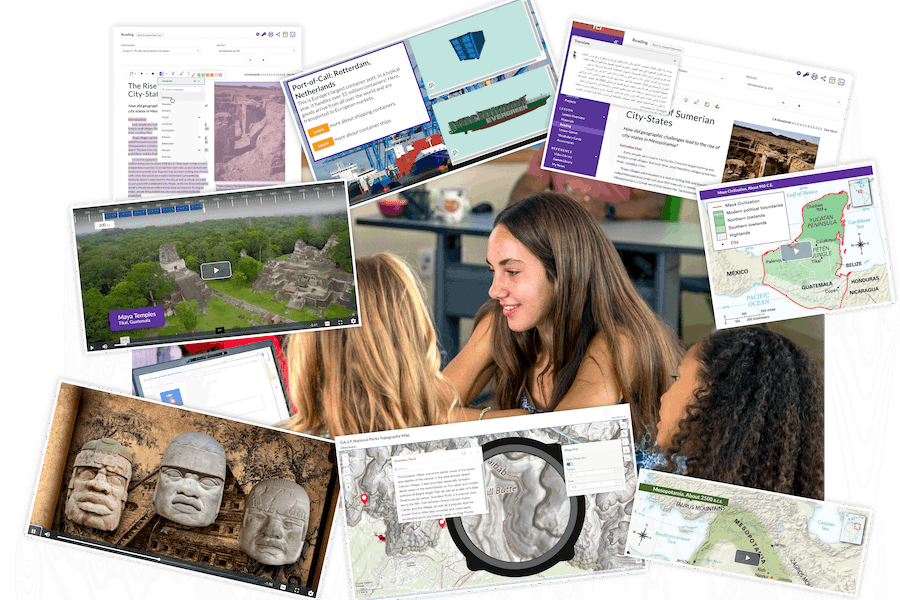
In TCI’s K-12 programs, disciplinary literacy is built into every lesson by design. Students are not just reading about geography. They are using geographic tools to solve a problem. They are not just completing science units; they are working in engineering teams toward real solutions within real constraints. That kind of learning builds something durable.
Students who have spent time investigating real problems, evaluating sources, and collaborating toward a shared answer are not just better prepared for an AI world. They are better prepared for life.
Expert Perspectives on AI
and K-12 Teaching
Teachers have always grabbed the latest technology and made it work — from the chalkboard to the filmstrip player to the internet. AI is next. That instinct is what has always driven TCI’s curriculum design.
Bert Bower, TCI Founder
Teachers face a staggering amount of differentiation every day, across instruction, activities, and assessments. Gaps of multiple grade levels and varied English language proficiency are overwhelming to plan for. AI tools that support differentiation in instruction, independent activities, and assessment questions give teachers time back for student-facing interactions, so they can provide the right level of support for every student.
Melanie Sutherland, TCI Customer Consultant and Former Teacher/Instructional Coach
The same principle that guides most of our product decisions guided our AI framework: teachers first. That means every feature we consider gets evaluated against a clear bar. Does it support the learning experience, or does it get in the way of it? That filter keeps our decisions grounded, even when the technology is moving fast.
Morris Thai, Head of Product Management
AI can generate answers, but students still need to know how to ask good questions, weigh evidence, recognize perspective, and explain their thinking. Digital citizenship should not feel separate from academic learning. At TCI, our focus on disciplinary literacy helps students evaluate information more thoughtfully, while our engaging classroom strategies help them practice the collaboration, communication, and real-world problem-solving skills they need beyond the screen.
TCI is not using AI to automate the learning experience. These features are designed to give teachers more time and capacity to engage students, drive discussion, and bring learning alive.
“If you’re a good teacher, you’re actually already doing a really good job of preparing students to live in a world of AI.”
— Brian Thomas, Learning Designer, TCI
Brian Thomas, TCI’s Learning Designer, has spent two decades in and around the middle school classroom. His full take is in our blog.
How TCI Evaluates and Builds AI for K-12 Classrooms
Teachers guide the classroom. Students engage and grow.
AI works in the background when teachers want it to.
TCI’s AI Framework
As we explored using AI to support educator needs, we recognized the importance of a guiding framework. We consulted established standards for the responsible use of AI in education to inform our approach. This framework guides how we evaluate, build, and refine AI features in our app.
Purpose. AI features are thoughtfully designed to save teachers time and improve student outcomes. Every feature is evaluated regularly to ensure it delivers results for teachers and works as intended for all learners.
Safety. TCI does not use teacher or student data to train AI models. AI features use only the data necessary for personalization. See TCI’s data privacy policy for more information.
Transparency. AI-generated content is clearly labeled and grounded in TCI’s professionally created, standards-aligned materials. Teachers can edit AI-generated content, and TCI collects feedback on all of it.
Access Control. Districts and teachers have control. Features that display AI-generated content can be opted into at the district or teacher level, so every school can decide what is right for their students.
EDSAFE AI Industry Council Member
TCI is a member of the EDSAFE AI Industry Council, joining education and technology companies committed to AI that is safe, accountable, fair, and effective.
Student Data Privacy and Safety
TCI does not use teacher or student data to train AI models. AI features use only the data necessary for personalization. All AI-generated content in TCI is grounded in TCI’s professionally created, standards-aligned materials and is clearly labeled so teachers always know what they are seeing. Districts and teachers have control over which AI features are active. Features that display AI-generated content are opt-in at the district or teacher level.
AI Literacy: Helping Students Navigate AI Content
A new TCI lesson that helps students evaluate AI-generated content, check sources, and build the digital literacy skills every AI-ready classroom needs.
Ready to explore how TCI supports teachers with AI? Reach out to access reviewer resources, request a sample module, or connect with a curriculum expert about what AI-powered differentiation, assessment, and grading support looks like in your classroom.
No and TCI’s curriculum doesn’t require it. TCI’s social studies and science programs are built on strong instructional design, active learning, and high-quality materials that work without any AI features. Where AI adds value is in reducing the administrative load on teachers: differentiating reading levels, building assessments, and supporting grading. If those aren’t pain points for you, the core curriculum stands on its own.
What if I don't want to use AI in my classroom?
That is completely fine. TCI’s AI features are opt-in at the district and teacher level. Teachers who prefer not to use AI-generated content can continue using TCI exactly as they always have. Nothing in the core curriculum changes. AI is an option, not a requirement.
Is my students' data safe?
Yes. TCI does not use teacher or student data to train AI models. AI features use only the data necessary for personalization. For full details, see TCI’s privacy policy at teachtci.com/privacy-policy.
Can our district control which AI features are turned on?
Yes. Features that display AI-generated content are opt-in at the district or teacher level. Every school can decide what is right for their teachers and students.
How does AI fit into TCI's existing curriculum?
TCI’s AI features are built directly into the programs teachers already use and are grounded in TCI’s professionally created, standards-aligned content. AI-generated content is clearly labeled.
Which grades and subjects do the AI features support?
TCI’s AI features are available across its K-12 social studies and science programs. Feature availability varies by program. Contact a curriculum expert for details specific to your grade level and subject.
How is TCI's approach to AI different from other curriculum providers?
TCI starts with the belief that good teaching has to come first. AI features are designed to support strong instructional foundations, not substitute for them. Every feature is evaluated against TCI’s guiding framework: Purpose, Safety, Transparency, and Access Control.
Never Miss a TCI Update
Sign up to get the latest on TCI programs, products, and professional development offerings.